


Ethereum is a decentralized, open-source blockchain platform that enables the creation and execution of smart contracts and decentralized applications (dApps) without the need for intermediaries. Launched in 2015, Ethereum expanded the scope of blockchain technology beyond simple peer-to-peer payments and laid the foundation for decentralized finance (DeFi), non-fungible tokens (NFTs), and Web3.
While Bitcoin introduced the concept of decentralized digital money, Ethereum introduced the idea of a programmable blockchain.
The History of Ethereum
Origins and Vision (2013–2014)
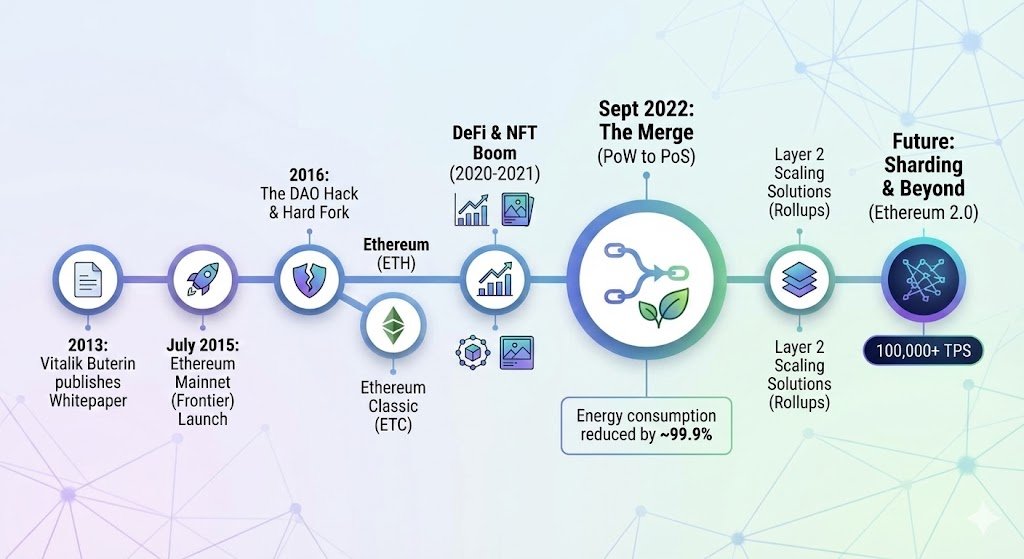
Ethereum was proposed in late 2013 by Vitalik Buterin, a programmer and co-founder of Bitcoin Magazine. Buterin believed Bitcoin’s scripting language was too limited to support complex applications. His vision was a blockchain with a built-in, Turing-complete programming language that could execute any logic.
In early 2014, Ethereum gained momentum when several co-founders joined the project, including:
- Vitalik Buterin
- Gavin Wood (author of the Ethereum Yellow Paper)
- Joseph Lubin
- Anthony Di Iorio
- Charles Hoskinson
To fund development, Ethereum conducted one of the earliest large-scale Initial Coin Offerings (ICO) in mid-2014, raising over $18 million by selling Ether (ETH), the network’s native currency.
Ethereum Launch and Early Development (2015–2016)
Ethereum officially launched on July 30, 2015, with its first version known as Frontier. This release allowed developers to deploy smart contracts and begin experimenting with decentralized applications.
In 2016, Ethereum faced a defining moment: The DAO hack. The DAO (Decentralized Autonomous Organization) was a smart-contract-based investment fund that raised approximately $150 million in ETH. A vulnerability in its code was exploited, resulting in the loss of around $60 million worth of ETH.
To recover the stolen funds, the community voted to perform a hard fork, which split the blockchain into:
- Ethereum (ETH) – the forked chain with recovered funds
- Ethereum Classic (ETC) – the original chain preserving immutability
This event shaped Ethereum’s governance philosophy and sparked ongoing debates about decentralization and intervention.
Ethereum’s Core Technology
Smart Contracts
Smart contracts are self-executing programs stored on the blockchain. They automatically enforce rules and agreements when predefined conditions are met. Once deployed, smart contracts are:
- Transparent
- Immutable
- Trustless
This innovation enables applications such as decentralized exchanges, lending platforms, games, and NFTs.
Ethereum Virtual Machine (EVM)
The Ethereum Virtual Machine (EVM) is the runtime environment that executes smart contracts. It ensures that all Ethereum nodes process transactions in the same way, maintaining consensus across the network.
The EVM has become an industry standard, with many blockchains (e.g., BNB Chain, Polygon, Avalanche) offering EVM compatibility.
Ether (ETH)
Ether (ETH) is Ethereum’s native cryptocurrency and serves multiple purposes:
- Paying transaction fees (gas)
- Staking to secure the network
- Acting as a medium of exchange within dApps
- Serving as a store of value for many users
Ethereum’s Evolution and Major Upgrades
Proof of Work to Proof of Stake
Originally, Ethereum used Proof of Work (PoW), similar to Bitcoin. However, scalability, energy consumption, and security concerns led to a long-term plan to transition to Proof of Stake (PoS).
The Merge (2022)
In September 2022, Ethereum completed The Merge, transitioning from PoW to PoS. This reduced Ethereum’s energy consumption by over 99% and changed how the network is secured:
- Validators stake ETH instead of mining
- Blocks are proposed and validated based on stake
Scalability Improvements
Ethereum’s popularity exposed limitations, including high gas fees and network congestion. To address this, Ethereum adopted a layered scaling strategy:
- Layer 2 solutions: Optimistic Rollups and ZK-Rollups (e.g., Arbitrum, Optimism)
- Sharding (future upgrades): Designed to increase throughput by splitting data across shards
Ethereum Ecosystem and Use Cases
Decentralized Finance (DeFi)
Ethereum is the backbone of DeFi, enabling:
- Lending and borrowing protocols
- Decentralized exchanges (DEXs)
- Stablecoins and synthetic assets
Platforms like Uniswap, Aave, and MakerDAO operate primarily on Ethereum.
Non-Fungible Tokens (NFTs)
Ethereum popularized NFTs, enabling digital ownership of:
- Art and collectibles
- Music and media
- In-game assets and virtual land
The ERC-721 and ERC-1155 standards are widely adopted across the NFT ecosystem.
Web3 and DAOs
Ethereum supports:
- Web3 applications, where users control their data and identity
- Decentralized Autonomous Organizations (DAOs), enabling on-chain governance and collective decision-making
Challenges and Criticisms
Despite its success, Ethereum faces ongoing challenges:
- High transaction fees during peak demand
- Competition from faster, lower-cost blockchains
- Technical complexity for new developers and users
- Regulatory uncertainty around cryptocurrencies and DeFi
Ethereum’s roadmap aims to address these concerns through continued upgrades and ecosystem innovation.
The Future of Ethereum
Ethereum’s long-term vision is to become a global settlement layer for decentralized applications. With ongoing improvements in scalability, security, and usability, Ethereum aims to support billions of users while remaining decentralized.
Key future goals include:
- Improved rollup integration
- Data sharding and performance optimization
- Enhanced developer tooling
- Broader institutional and enterprise adoption
Conclusion
Ethereum represents a fundamental shift in how digital systems are built and governed. From its origins as an ambitious idea by a young programmer to its role as the foundation of DeFi, NFTs, and Web3, Ethereum has reshaped the blockchain landscape.
While challenges remain, Ethereum’s strong developer community, continuous innovation, and proven resilience position it as one of the most influential technologies in the digital economy.