
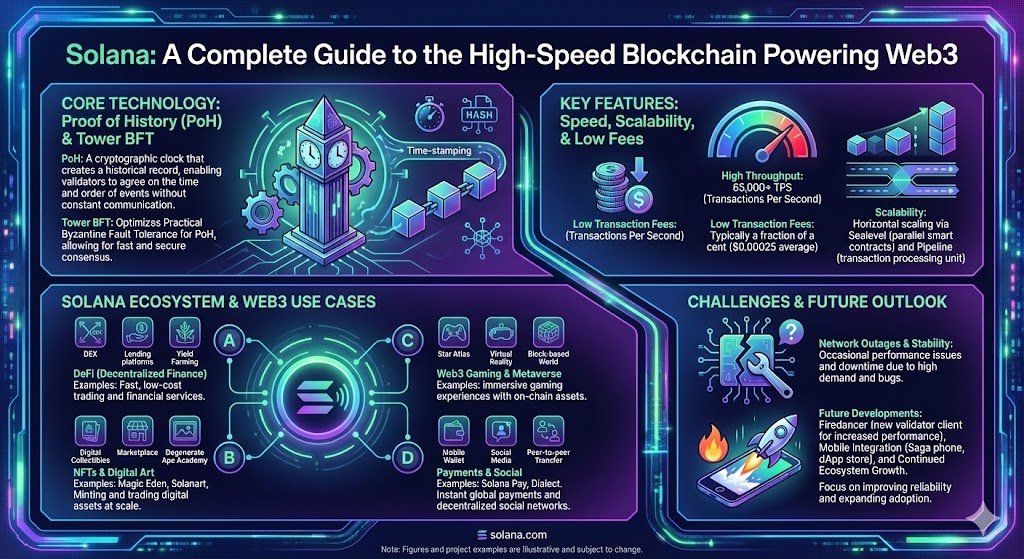


Solana has emerged as one of the most talked-about blockchain platforms in the cryptocurrency industry, known for its exceptional transaction speed and low costs. As the demand for scalable Web3 solutions continues to rise, Solana positions itself as a strong alternative to older blockchain networks struggling with congestion and high fees.
From decentralized finance (DeFi) and NFTs to gaming and Web3 applications, the Solana ecosystem is expanding rapidly. This article provides a complete, unbiased overview of Solana, how the Solana blockchain works, its real-world use cases, price trends, and how it compares to competitors like Ethereum. Whether you are a crypto enthusiast, investor, or developer, this guide will help you understand why Solana crypto remains a key player in the blockchain market.
What Is Solana?
Solana is an open-source, Layer-1 blockchain designed to support fast, secure, and scalable decentralized applications. Launched in 2020 by Solana Labs, the network aims to solve common blockchain challenges such as slow transaction speeds and high fees.
The native cryptocurrency of the network is the SOL token, which is used to pay transaction fees, participate in staking, and secure the Solana network. Unlike many traditional blockchains, Solana focuses heavily on performance, making it attractive for high-throughput applications.
How the Solana Blockchain Works
The Solana blockchain introduces a unique approach to consensus by combining two mechanisms:
Proof of History (PoH)
Proof of History is Solana’s innovative time-keeping system. It creates a cryptographic timestamp that proves when events occurred, allowing the network to process transactions efficiently without waiting for full network confirmation.
Proof of Stake (PoS)
Solana also uses Proof of Stake to validate transactions and secure the network. Validators stake SOL tokens to help process transactions and maintain decentralization.
By combining PoH and PoS, Solana can process thousands of transactions per second, making it one of the fastest blockchains in operation.
Key Features of Solana
1. High Transaction Speed
Solana can handle up to 65,000 transactions per second (TPS) under optimal conditions, significantly outperforming many competitors.
2. Low Transaction Fees
Solana transactions typically cost a fraction of a cent, making it ideal for micro-transactions, DeFi, and NFT trading.
3. Scalability
The Solana network scales without relying on Layer-2 solutions, reducing complexity for developers and users.
4. Growing Developer Ecosystem
Solana supports modern development tools and programming languages, attracting startups and enterprises alike.
Solana Use Cases
Decentralized Finance (DeFi)
Solana hosts a wide range of DeFi platforms, including decentralized exchanges, lending protocols, and yield-farming applications. Low fees and fast settlement times give Solana a competitive edge in DeFi.
NFTs and Digital Assets
The Solana ecosystem supports popular NFT marketplaces where users can mint, trade, and collect NFTs at much lower costs compared to Ethereum-based platforms.
Web3 and dApps
Many Web3 applications are built on Solana due to its performance and developer-friendly infrastructure.
Blockchain Gaming
Solana’s speed makes it suitable for blockchain games that require real-time interactions and frequent transactions.
Solana vs Ethereum
Solana is often compared with Ethereum, the most widely used smart contract platform.
| Feature | Solana | Ethereum |
|---|---|---|
| Transactions per second | Very high | Moderate |
| Transaction fees | Very low | Often high |
| Consensus | PoH + PoS | PoS |
| Ecosystem maturity | Growing | Very mature |
While Ethereum has a larger ecosystem, Solana offers speed and affordability, making it attractive for new projects and users.
Solana Price and Market Performance
The Solana price has experienced significant volatility, reflecting broader crypto market trends. SOL gained attention during bullish cycles due to rapid ecosystem growth and increased adoption.
Key factors influencing Solana crypto price include:
- Network adoption
- Developer activity
- Market sentiment
- Overall cryptocurrency trends
For up-to-date pricing, many users rely on trusted crypto exchanges and market-tracking platforms. (Affiliate note: Always use reputable exchanges with strong security records.)
Advantages and Disadvantages of Solana
Advantages
- Extremely fast transaction speeds
- Very low transaction costs
- Strong focus on scalability
- Active developer and user community
Disadvantages
- Network outages in the past
- Ecosystem still smaller than Ethereum
- Higher hardware requirements for validators
A balanced view is essential when evaluating any blockchain investment or technology.
The Future of Solana
The future of Solana depends on continued network stability, ecosystem expansion, and real-world adoption. With increasing interest in Web3, DeFi, and NFTs, Solana remains well-positioned to capture market share.
Ongoing upgrades, partnerships, and developer activity suggest that the Solana ecosystem will continue to evolve. However, as with all crypto projects, market risks remain.
Conclusion
Solana has established itself as a high-performance blockchain designed for the next generation of decentralized applications. Its combination of speed, low fees, and scalability makes it a compelling option for developers and users alike.
Whether you are exploring Solana for investment research, Web3 development, or general crypto education, understanding how the Solana blockchain works is essential. As adoption grows, Solana crypto is likely to remain a major topic in blockchain and cryptocurrency news.