
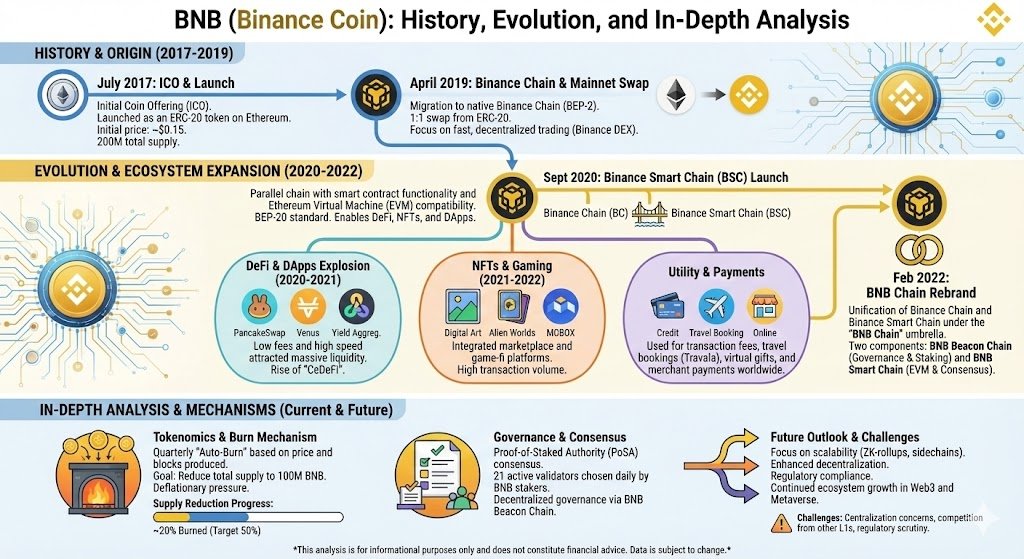


BNB is the native cryptocurrency of the BNB Chain ecosystem, one of the most widely used blockchain networks in the world. Originally launched as Binance Coin, BNB began as a utility token for trading fee discounts on the Binance exchange. Over time, it evolved into a core asset powering smart contracts, decentralized applications (dApps), DeFi protocols, NFTs, and governance across multiple blockchains.
Today, BNB is more than an exchange token—it is the economic backbone of a large, high-throughput blockchain ecosystem.
History of BNB
Origins: Binance Coin (2017)
BNB was launched in July 2017 by Binance, one of the world’s largest cryptocurrency exchanges, founded by Changpeng Zhao (CZ). The token was introduced through an Initial Coin Offering (ICO), raising approximately $15 million.
At launch:
- BNB was issued as an ERC-20 token on the Ethereum blockchain
- Total supply: 200 million BNB
- Primary use case: discounted trading fees on Binance
The early success of Binance directly fueled BNB’s adoption and market value.
Token Burn Mechanism
From the beginning, Binance committed to reducing BNB’s total supply through quarterly token burns, using a portion of exchange profits. The goal is to permanently remove 100 million BNB (50% of total supply) from circulation.
Later, this evolved into the Auto-Burn mechanism, which adjusts burn amounts based on:
- BNB price
- Network activity
This deflationary model is a key factor in BNB’s long-term value proposition.
Transition to Binance Chain and BNB Chain
Binance Chain (2019)
In April 2019, Binance launched Binance Chain, a high-performance blockchain optimized for fast asset transfers and decentralized trading. BNB migrated from Ethereum to become the native coin of Binance Chain.
Key features:
- Extremely fast block times
- Limited smart contract functionality
- Focus on decentralized exchange (Binance DEX)
Binance Smart Chain (BSC) – 2020
To support smart contracts and decentralized applications, Binance launched Binance Smart Chain (BSC) in September 2020.
Key innovations:
- EVM compatibility, allowing Ethereum dApps to migrate easily
- Lower transaction fees compared to Ethereum
- Dual-chain architecture with Binance Chain
This move triggered massive growth in DeFi adoption on BSC.
Rebranding to BNB Chain (2022)
In 2022, Binance rebranded its blockchain ecosystem as BNB Chain, redefining BNB as:
Build and Build
BNB Chain consists of:
- BNB Beacon Chain (governance and staking)
- BNB Smart Chain (BSC) (smart contracts and dApps)
This shift emphasized decentralization and ecosystem growth beyond the Binance exchange.
Core Technology of BNB Chain
Consensus Mechanism: Proof of Staked Authority (PoSA)
BNB Smart Chain uses Proof of Staked Authority (PoSA), a hybrid of:
- Proof of Stake (PoS)
- Proof of Authority (PoA)
Key characteristics:
- Limited number of validators (21 active validators)
- Fast block production (~3 seconds)
- High throughput and low fees
While efficient, PoSA has raised debates around decentralization compared to Ethereum.
Smart Contracts and EVM Compatibility
BNB Smart Chain is fully EVM-compatible, enabling:
- Solidity smart contracts
- Easy porting of Ethereum dApps
- Familiar developer tooling (MetaMask, Hardhat, Remix)
This compatibility accelerated ecosystem growth significantly.
BNB Utility and Use Cases
BNB has multiple real-world and on-chain utilities:
1. Transaction Fees
- Pay gas fees on BNB Smart Chain
- Fees are significantly lower than Ethereum L1
2. Staking and Validation
- Stake BNB to support validators
- Earn staking rewards
3. Exchange Utility
- Trading fee discounts on Binance
- Used in Binance Launchpad and Launchpool
4. DeFi and dApps
- Lending, borrowing, yield farming
- Liquidity provision on DEXs like PancakeSwap
5. NFTs and Gaming
- NFT marketplaces
- Blockchain games and metaverse projects
BNB Ecosystem Growth
DeFi Expansion
BNB Chain became a major DeFi hub during 2020–2021, hosting:
- PancakeSwap
- Venus
- Alpaca Finance
Its low fees attracted retail users priced out of Ethereum.
NFTs and Web3
BNB Chain supports:
- NFT minting and trading
- Web3 wallets and identity
- DAO frameworks
The ecosystem continues to expand through grants and developer incentives.
Challenges and Criticisms
Despite its growth, BNB and BNB Chain face criticism:
- Centralization concerns due to validator structure
- Heavy association with Binance exchange
- Regulatory scrutiny impacting Binance may affect BNB
- Competition from Ethereum Layer 2s and other L1 blockchains
The BNB Chain roadmap aims to address these concerns through increased decentralization and infrastructure upgrades.
Security and Network Incidents
BNB Chain has experienced security incidents, including cross-chain bridge exploits. In response:
- Network upgrades were implemented
- Validator coordination improved
- Emphasis placed on security audits and monitoring
These events highlighted both the risks and responsiveness of the ecosystem.
The Future of BNB and BNB Chain
BNB’s future vision includes:
- Expansion of decentralized governance
- Improved validator decentralization
- Enhanced scalability and cross-chain interoperability
- Stronger focus on Web3, AI, and real-world asset tokenization
BNB aims to remain a high-performance blockchain for mass adoption.
Conclusion
BNB’s journey from a simple exchange utility token to the core asset of a global blockchain ecosystem reflects the rapid evolution of the crypto industry. With strong infrastructure, a massive user base, and continuous development, BNB plays a critical role in DeFi, NFTs, and Web3 adoption.
While debates around decentralization and regulation persist, BNB’s utility, ecosystem depth, and deflationary economics ensure its continued relevance in the blockchain landscape.